
 +48 791-027-207
 drzewkakusek@gmail.com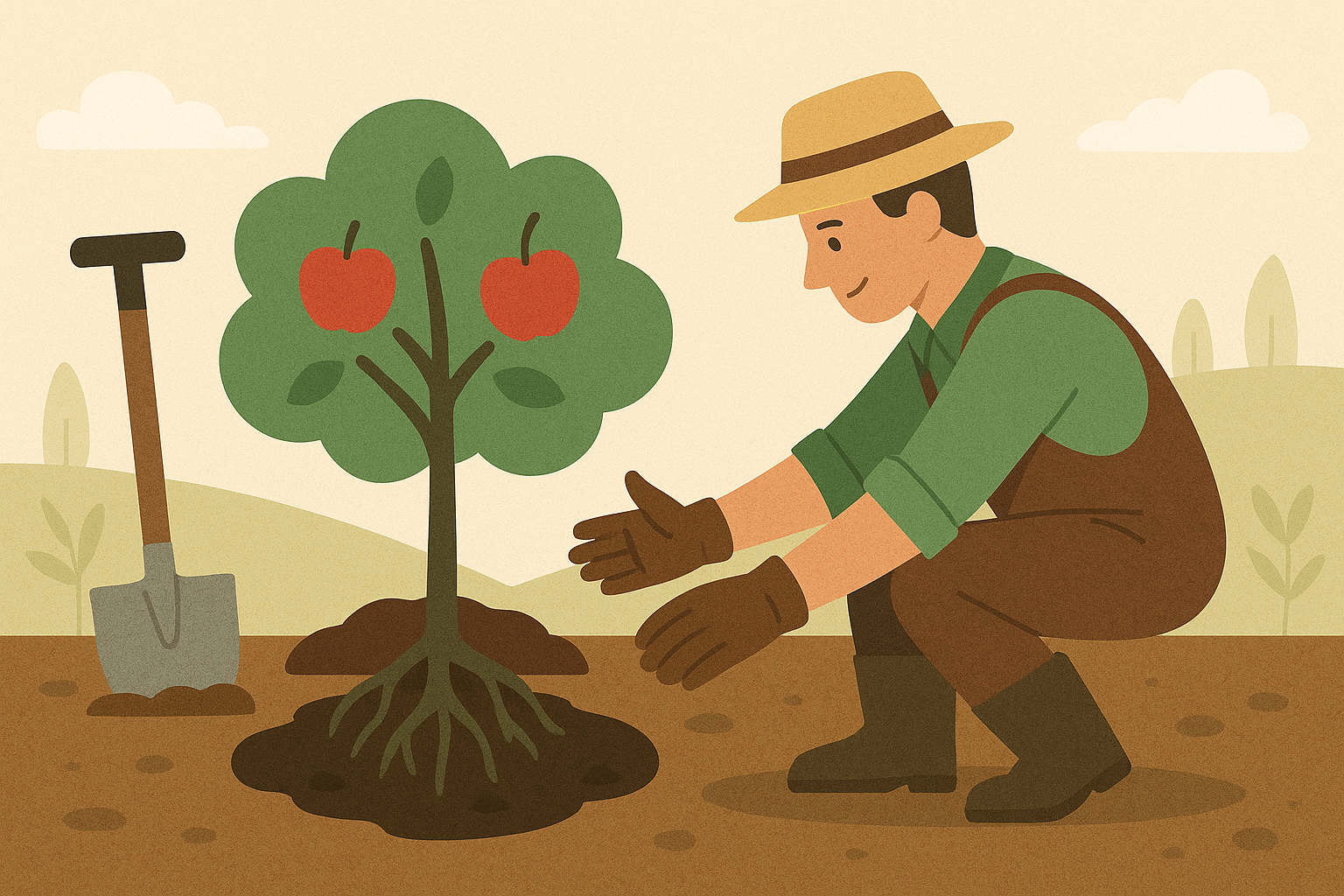
Looking for fruit tree seedlings for autumn planting? At the Drzewka Kusek nursery we run our own production — apple, pear, plum, sweet cherry, sour cherry, peach, apricot and nectarine trees, healthy and adapted to Central European conditions. Retail and wholesale, Podkarpacie region, Poland.
In a Central European climate, autumn is the best time to establish an orchard or add new trees to the garden. A tree planted in October or November has several months to regenerate its roots before growth starts — so in spring it gets a head start that later planting cannot make up for. Below you will find specific dates, the order of work and the mistakes that most often cost gardeners a tree that fails to establish.
When to plant fruit trees in autumn? Specific dates
The autumn planting season opens when the trees have dropped their leaves and closes when the ground freezes. In most of Poland this means a window from mid-October to the end of November. In warmer years you can still plant in early December, as long as the soil stays unfrozen.
The key rule: a tree needs about 4–6 weeks of unfrozen soil after planting to grow new fine root hairs. That is why planting on 20 October is much safer than on 25 November, even though both dates formally fall within the season.
- Optimal: from mid-October to mid-November.
- Still acceptable: the second half of November, in mild weather.
- Too late: when the soil is frozen or a lasting frost is forecast within a few days.
If you do not manage to plant before the frost, do not force it. A better solution is heeling in — laying the trees at an angle in a shallow trench and covering the roots and part of the trunk with soil. Stored this way, the trees will survive the winter and you can plant them in early spring.
Which species to plant in autumn and which in spring?
This is the most often overlooked question — and it decides whether the tree survives the winter. Pome fruit (apple, pear) and plum tolerate autumn planting well. Warmth-loving stone fruit — peach, apricot, nectarine — is sensitive to frost damage in the first year, and in our conditions it is safer to plant it in spring.
| Species | Autumn (Oct–Nov) | Spring (Mar–Apr) | Notes |
|---|---|---|---|
| Apple | recommended | possible | Tolerates autumn planting best, also on dwarfing rootstocks. |
| Pear | recommended | possible | As for apple; needs a site sheltered from the wind. |
| Plum | recommended | possible | In cold areas and frost pockets consider spring. |
| Sour cherry | possible | recommended | In autumn plant early, preferably in October. |
| Sweet cherry | with caution | recommended | Young trees are sensitive to frost damage of the trunk and graft union. |
| Peach | not advised | recommended | Warmth-loving species — plant in spring, after the last frosts. |
| Apricot | not advised | recommended | As for peach; also needs a warm, sheltered site. |
| Nectarine | not advised | recommended | The most sensitive stone fruit — spring planting only. |
You will find planting material on the pages of the individual species, with the varieties and rootstocks from our nursery: apple tree seedlings, pear tree seedlings, plum tree seedlings, sour cherry seedlings, sweet cherry seedlings, peach tree seedlings, apricot tree seedlings and nectarine tree seedlings.
Why plant fruit trees in autumn?
The advantage of autumn planting comes from the fact that a tree’s roots keep working longer than its above-ground parts. Once the leaves have fallen and the soil is still a few degrees above zero, the tree does not have to “feed” anything — it puts all its energy into rebuilding the root system damaged when it was lifted in the nursery.
- Better rooting before spring — the tree starts growing with a working root system, instead of building it at the same time as its leaves.
- Greater drought tolerance — deeper-rooted trees cope much better with summer water shortages in the following season.
- Less watering — autumn rain and low evaporation keep the soil moist on their own.
- Natural settling of the soil — over winter the soil closes tightly around the roots, without air pockets.
- Wider choice of trees — in autumn nurseries have their full range of varieties and rootstocks; by spring the most popular ones are often sold out.
- A calmer work schedule — autumn planting does not clash with the spring rush of jobs in the garden and orchard.
How to prepare the site and the planting hole?
Ideally, start preparing the site 2–4 weeks before planting. The soil then has time to settle, and any organic fertiliser you add can partly break down.
Fruit trees need a sunny, airy site, but one that is not exposed to strong winds. Avoid frost pockets — valleys and hollows where cold air and water collect. The groundwater level should be at least 1.5 m below the soil surface.
Dig a hole twice as wide as the root system and deep enough for the roots to fit freely without bending. Keep the (more fertile) topsoil separate from the deeper layer — when filling in, it goes back to the bottom, right next to the roots.
Mix compost or well-rotted manure into the excavated soil. Never use fresh manure — it burns the roots and encourages rot. In autumn use phosphorus and potassium fertilisers; skip nitrogen, as it stimulates shoot growth that will not have time to harden before the frost.
Planting fruit trees step by step
- Prepare the tree. Trim damaged and dried-out root tips with sharp secateurs. If the tree has been in transit, soak the roots in water for 2–4 hours.
- Drive in the stake before planting the tree — not after. A stake driven in later will inevitably damage the roots. Place it on the side of the prevailing wind.
- Set the tree on a mound of soil at the bottom of the hole and spread the roots evenly sideways and downwards.
- Check the depth — this is the most important moment. The graft union (the bulge on the trunk) must sit 5–10 cm above soil level. If the tree is planted too deep, the grafted variety grows its own roots and the rootstock no longer controls its vigour.
- Fill in in stages, gently shaking the tree so the soil fills the gaps between the roots. Firm each layer lightly with your foot, without excessive force.
- Form a basin around the trunk and water generously — 15–20 litres per tree, even if the soil is moist. The point is to settle the soil around the roots, not to irrigate.
- Tie the tree to the stake with a soft tie in a figure of eight, loosely — the trunk must have room to thicken.
- Mulch with a 5–8 cm layer of bark, straw, sawdust or compost, leaving a few centimetres of free space right next to the trunk.
How to protect young trees over winter?
A tree planted in autumn goes into winter with an incomplete root ball, so it needs protection that spring planting does not require.
- Earthing up — pile a 20–30 cm mound of soil around the trunk. It protects the graft union and the base of the trunk from frost. Spread the mound out in spring.
- Protection against rodents and hares — a spiral guard, mesh or plastic sleeve on the lower 50–60 cm of the trunk. In winter the bark of young trees is easy food for animals, and bark gnawed all the way around the trunk kills the tree for good.
- Whitewashing the trunks — with lime or ready-made garden paint. It protects against frost cracks, which form in February and March when the sun warms the dark bark by day and the temperature drops sharply at night.
- Mulch — besides protecting against frost, it limits repeated freezing and thawing of the soil, which pushes freshly planted trees upwards.
- Checks after thaws and storms — make sure the tree has not been lifted out of the soil and that the tie is not cutting into the trunk.
Common mistakes when planting in autumn — what to avoid
- Planting too deep. By far the most common mistake. A graft union below ground means losing control over the tree’s vigour and delaying fruiting by several years.
- Fresh manure in the planting hole. Burnt roots and rot. Use only composted material mixed with soil.
- Nitrogen fertiliser in autumn. It stimulates shoot growth that will not harden before the frost and will be damaged.
- Skipping watering. “But the soil is wet” — watering after planting settles the soil around the roots; it is not about irrigation.
- A stake driven in after planting. It tears the roots you have just carefully spread out.
- A tight wire or string tie. Within a year it cuts into the bark and constricts the trunk.
- Dried-out roots. A bare-root tree cannot wait in the sun and wind. Until planting, keep the roots covered with a damp cloth or in water.
- Planting warmth-loving species in autumn. Peach, apricot and nectarine are for spring planting.
- Formative pruning right after planting. With autumn planting, pruning is postponed until early spring — wounds heal poorly in winter.
The first weeks after planting
In autumn the tree needs little attention, but a few things are worth doing. If November is exceptionally dry, water once more before the frost — dry soil freezes deeper than moist soil. Keep grass and weeds away within about a metre of the trunk, as they compete for water and nutrients.
Postpone pruning after planting until March. Then shorten the leader and side shoots, shaping the crown to suit the species and rootstock. In spring, also spread out the soil mound and check the rodent guards.
Frequently asked questions about autumn planting
Can you plant fruit trees in November?
Yes, as long as the ground is not frozen. The first half of November is still a good time. In the second half of the month plant only if the forecast is mild — the tree still needs a few weeks of unfrozen soil to root.
Autumn or spring planting — which is better?
For apple, pear and plum trees autumn is the better time: the trees root before spring and start more strongly. For peach, apricot, nectarine and — in colder regions — sweet cherry, spring is safer because young trees are sensitive to frost damage.
How deep should a fruit tree be planted?
So that the graft union sits 5–10 cm above soil level. This is the most important parameter of the whole job — planting too deep cancels the effect of the rootstock and delays fruiting.
Do trees planted in autumn need watering?
Right after planting — definitely, 15–20 litres per tree, whatever the soil moisture. Later only if the autumn is clearly dry. The tree does not need watering over winter.
What if I cannot plant the trees before the frost?
Heel them in: lay them at an angle in a shallow trench and cover the roots and the lower part of the trunk with soil, pressing it down well. Stored this way, the trees will survive the winter and you can plant them in March or April.
When will a tree planted in autumn start bearing fruit?
It depends mainly on the rootstock. Trees on dwarfing rootstocks usually bear fruit in the 2nd–3rd year after planting, on semi-dwarfing rootstocks in the 3rd–4th, and on vigorous ones only in the 4th–6th year. You can read more about this in our guide to fruit tree rootstocks.
Planning autumn planting?
We run our own fruit tree production in Podkarpacie, south-eastern Poland — from our own scion orchard, on rootstocks matched to soil and site. We can help you choose varieties and rootstocks and prepare the trees for an agreed collection date. Retail and wholesale.
Gospodarstwo Rolne Paweł Kusek · Dąbie 140, 39-311 Dąbie, Poland · tel. +48 791 027 207